
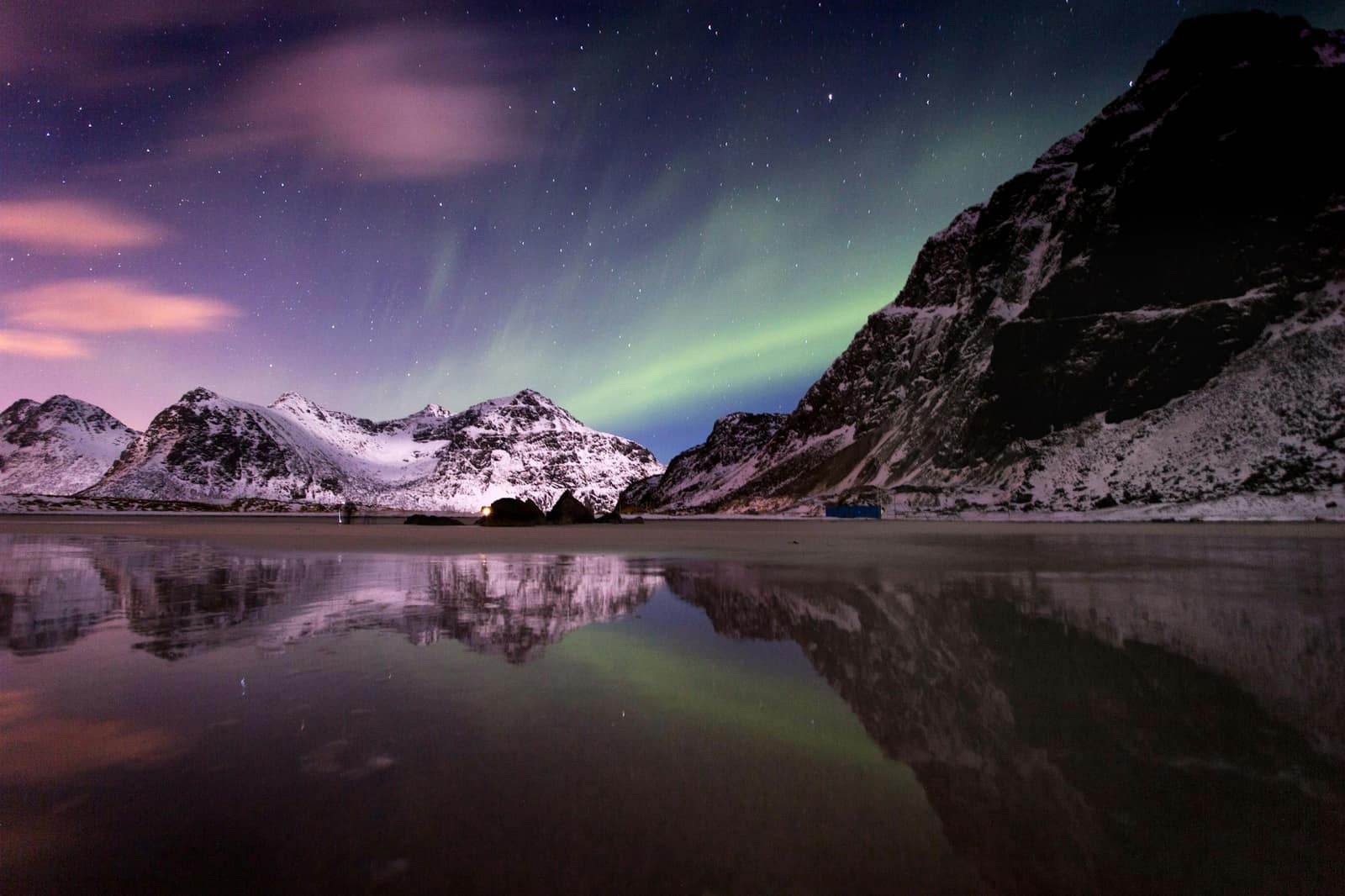
Northern lights, private journeys
Northern lights, January to March.
Three months of long, dark nights in the places where the sky has room to move. Where to go, why these months, and what a night looks like. We cannot promise the sky; we can put you under it.
Ask us about your dates
Tell us the week you have in mind. We say where the sky is most likely to be open, and how many nights to give it.
Ask us about your dates Begin a conversation
Write to hello@unforgettablenordic.com. A founder replies within 24 hours.
Why these three months
The aurora needs two things: darkness and an active sun. January to March gives the first in generous measure.
These are hours of real darkness, with the sun at least 12 degrees below the horizon, in the middle of each month. We work them out from the sun's position, as on our daylight pages.
| Place | January | February | March |
|---|---|---|---|
| Abisko | 15 hours | 12 hours | 8 hours |
| Tromsø | 15 hours | 12 hours | 8 hours |
| Rovaniemi | 15 hours | 12 hours | 9 hours |
| Reykjavík | 14 hours | 12 hours | 9 hours |
| Akureyri | 15 hours | 12 hours | 9 hours |
The second need is the sun. Activity in the Earth's magnetic field tends to be higher around the March and September equinoxes, which NASA notes as the reason astronauts are especially likely to see lights in spring and autumn. It raises the odds; it never decides a night. The forecast we read is the NOAA planetary K-index, and tonight's outlook for each place is on our northern lights forecast.
Sources: NASA Science: auroras can occur at any time of year, and are especially likely around the spring and autumn equinoxes; NOAA Space Weather Prediction Center: the planetary K-index, the forecast we read.
Where to go
- Abisko and Kiruna, Swedish LaplandOne of the driest places in Sweden, so often clear. The aurora usually reaches here from about Kp 1.
- Tromsø, northern NorwayA city at 69.65 degrees north, under the aurora oval. The aurora usually reaches here from about Kp 0.
- Rovaniemi and Finnish LaplandThe gateway to Lapland, on the Arctic Circle. The aurora usually reaches here from about Kp 2.
- Reykjavík, south IcelandAurora and the south coast in one journey. The aurora usually reaches here from about Kp 1.
- Akureyri, north IcelandThe north, with long dark nights over the fjord. The aurora usually reaches here from about Kp 1.
A lower Kp number means the lights show with a quieter sun. Tonight, place by place The northern lights journeys Every country on the map
What a night looks like
A good night starts in the afternoon, with the forecast and the cloud, and ends whenever the sky says.
In the afternoon your guide reads the forecast for the place: how active the sun is, and where the cloud lies. By evening there is a plan, and a second one in case the sky disagrees. Dinner is early and unhurried.
The hours that tend to be best are the middle of the dark window, a few hours either side of it. Your guide takes you out then, to a dark place with an open horizon, often a drive away from the town. You wait in warm clothes, with a hot drink, and the show starts or it does not. When it does, it can begin as a faint arc in one corner of the sky and build, or it can rush overhead in minutes.
If the cloud is thick where you are, we drive toward the clear patch of sky. That is the reason we keep our journeys small: a plan that can change by breakfast, and a car that can leave at ten at night. The next day is for sleeping late and for the place itself. And then the next night.
Ways to go
A northern lights journey is the guided way: four nights or more, in dark places, with a person of ours on the ground. If you prefer to drive, the Iceland winter self-drive has a map for every day, such as day 3, Hella to Vík by the waterfalls and the ice and day 6, Jökulsárlón to Höfn, and the Lapland crossing runs from Luleå to Ivalo, with day 3 at Jukkasjärvi, the river and the ice. For a party that wants a house of its own, a private charter is arranged with the people who own it.
Questions people ask
What is the best place to see the northern lights in February?
There is no single best place, because the sky decides each night. The places we start from are Abisko in Swedish Lapland, where mountains to the west hold back the rain and the sky is often clear; Tromsø, where the aurora oval passes overhead on most clear nights; Finnish Lapland around Rovaniemi; and Iceland, in the north and the south. In February the nights are about 12 hours of real darkness in all of them. We choose with you, and we move on the night if the cloud says so.
Why January to March?
The nights are long. In the middle of January there are about 14 to 15 hours of real darkness, in February about 12, and in March about 8 to 9. Darkness is the first thing the aurora needs. Around the equinox in March the sun also tends to send more energy into the Earth's magnetic field, which raises the odds of a lively night without ensuring one.
Can you guarantee we will see the northern lights?
No, and nobody honestly can. The aurora depends on the sun and on clear sky, and both change by the hour. What we do is plan four nights or more, read the forecast each evening, and take you toward clear sky. Some nights show nothing, and that is why we plan for several.
How many nights should we plan?
Four or more. One night is a gamble on a single sky; four give the weather and the sun room to cooperate. We say how many nights suit your dates when we hear them.
Is March better than January?
Neither is better in a way we can promise. March is near the equinox, when activity tends to be higher, and it has fewer hours of full darkness than January. January has the longest nights. The best month is the one that fits your dates, and we plan for the sky you get.
What do I wear and bring?
Warm layers, wind-proof outer clothing, a hat, gloves and warm boots, and something warm to drink. We tell you what to bring for your place and dates before you travel.
Dark skies and season
Choose a place and a date. The hours of real darkness come from the same sun calculation as the daylight planner.
On 15 November at Tromsø: A good chance of dark enough skies: 14 h 07 min of real darkness. The moon, waxing crescent, stays below the horizon through the dark hours: no moonlight.
This is dark skies and season only. It does not forecast aurora activity and is no promise of a sighting.
Tell us your window
Give us the weeks you have and the places that draw you. We tell you honestly what the sky is likely to offer, and how many nights to give it.
Ask us about your dates Begin a conversation
Write to hello@unforgettablenordic.com. A founder replies within 24 hours.
Where these facts come from
Sources
- NASA Science: auroras can occur at any time of year, and are especially likely around the spring and autumn equinoxes
- NOAA Space Weather Prediction Center: the planetary K-index, the forecast we read
The hours of darkness are our own calculation from the sun's position, with the sun at least 12 degrees below the horizon, in the middle of each month, as on the forecast and daylight pages. The Kp each place needs is from our forecast data, which follows the NOAA index.