When should we book a northern lights journey for winter 2026/27?
Well ahead. The season runs September through March, and the December and January weeks close earliest. An enquiry placed in late summer or autumn 2026 keeps the full choice of regions, properties, and guides open; February and March 2027 hold availability longer and pair full aurora darkness with lengthening daylight.
Is winter 2026/27 still a strong aurora season now that solar maximum has passed?
Yes. Solar maximum passed around 2024-10, but strong displays are expected to continue. That is the published position of the UK Met Office blog of 2026-01-29 (Krista Hammond) and of Space.com’s reporting of 2025-12-18 (Ryan French). On any given night, cloud cover and geomagnetic activity matter more than the phase of the solar cycle.
Which country suits a private northern lights journey best: Iceland, Norway, Sweden, or Finland?
Finland for glass-roof cabins, families, and straightforward logistics; Sweden for Abisko’s rain-shadow microclimate; Norway for coastline, mobility, and daytime range; Iceland when the aurora is one thread of a wider journey rather than the whole point. Sightings in all four depend on weather and geomagnetic activity, so the choice is really about the week around the sky.
How do Abisko and Tromsø compare?
Abisko offers a rain-shadow microclimate with more clear nights from a fixed position; Tromsø offers a road network and coastline that let a private guide drive toward gaps in the cloud, plus a working town for the rest of the day. Staying put favours Abisko; range favours Tromsø. A week combining both, with a private overland leg between them, is a routing we build often.
What are glass cabins and ice hotels like?
A glass-roof cabin is a viewing instrument: the sky watched from a warm bed, which suits children and late-night displays. It works best as two or three nights inside a longer journey. The ice hotel at Jukkasjärvi, rebuilt each winter near Kiruna, is architecture first and accommodation second; we book it for the building, with the rest of the week in warm timber.
How does a private aurora chase work?
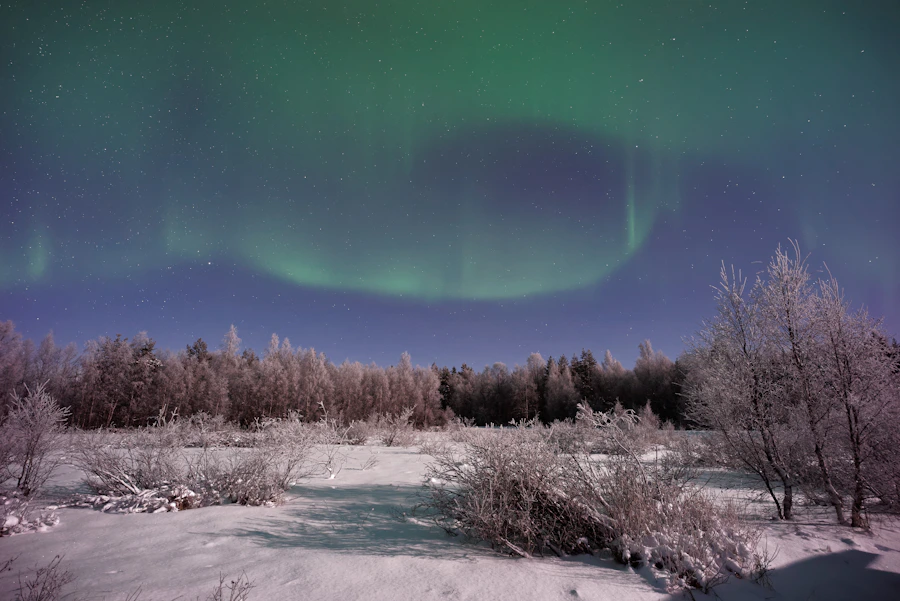
The guide reads cloud forecasts and geomagnetic data through the afternoon and decides each evening whether to stay at the lodge or drive. The vehicle carries one party only, the route follows the forecast rather than a schedule, and the night ends when the sky delivers or when the party decides. The chase does not change the sky, because sightings depend on weather and geomagnetic activity. What it changes is where the party stands under it.
Does a northern lights journey work with teenagers?
Better than most travel does. Late nights are the point of an aurora week, and the daytime programme of snowmobiling, husky teams, and sauna carries the trip when the sky is quiet. Each journey is designed for one party only, so the pace is the family’s own. Finland’s glass cabins and Norway’s activity range are the two grounds we reach for first.
What photography basics does the aurora ask for?
A camera with manual control, a wide lens at f/2.8 or faster, a tripod, and a spare battery kept warm. Start near ISO 1600–3200 with a shutter of 2–10 seconds depending on how fast the display moves, and set focus manually on a bright star. Recent phones with a night mode do respectable work from a small tripod. Guides on our journeys carry tripods and help with settings; the mistake to avoid is watching the whole display through a screen.