All year, with the light of each season stated in every day · Norway · 12 days
The Norwegian coastal voyage from Bergen to Kirkenes and back: 12 days
You are met at Bergen Airport or your hotel, board in Bergen, sail north across the Arctic Circle to Kirkenes, turn south, and arrive back in Bergen twelve days later.
Pickup: Bergen airport, to the terminal or your hotel in Bergen, to the terminal. Drop-off: Bergen airport, from the terminal or your hotel in Bergen, from the terminal.
The route: Bergen, then Floro, then Geiranger, then Alesund, then Trondheim, then Svolvær, then Tromsø, then Honningsvåg, then Kirkenes, then Tromsø, then Svolvær, then Brønnøysund, then Kristiansund, then Bergen Airport.
The journey at a glance
In short: A private 12-day journey for couples, families and friends from Bergen to Kirkenes and back along the Norwegian coast, sailing every month of the year, with pickup at Bergen Airport or your hotel.
Length
12 days
Season
All year, with the light of each season stated in every day
Style
An available journey, adaptable to your dates
Every journey here is a starting point: we adapt the days, the pace and the places to each guest. All the journeys
The whole journey, day by day. The numbered points mark where each day ends and the night is spent; select one to jump to that day.
Day 1 Bergen, the terminal and the first evening at sea
Bergen is where this voyage begins, and your driver meets you at Bergen Airport or at your hotel on the morning of departure. The airport lies 20.2 km and 28 minutes from the terminal by the routing estimate, and a hotel in the city centre lies 1.6 km and 5 minutes away. Your hotel is chosen by us for the room category and the location, and named at booking, subject to final confirmation. The terminal in Nøstegaten opens at 13:00 on departure days, takes luggage between 13:00 and 14:30, and starts check-in at 15:30.
Until then the town is yours, and it rewards a slow morning. The operator dates Bergen to 1070, and the wooden wharves of Bryggen, a UNESCO site from the Hanseatic years, stand a short walk from the Fish Market, where you can eat shrimp and salmon by the water. The funicular to the top of Mount Fløyen shows the island coast you are about to sail. Cabins are ready at 18:00, you must be at the terminal by 20:00, and the ship leaves at 20:30. It sails north through the Hjeltefjord, the old route of Viking longships. The light changes through the year, so your guide sets the hours by sunrise and sunset for your dates.
Along the way
Bergen Start of the day
Floro End of the day
The road of the day, on the coast. Select a point to read about the place.
The day, hour by hour
09:30Pickup at Bergen Airport or at your hotel; luggage to the terminal if you wish
11:00Bryggen, the Fish Market and the funicular to Fløyen, at your own pace
15:30Check-in opens at the terminal; the safety briefing follows
18:00Cabins are ready on board
20:30The ship leaves Bergen and sails north through the Hjeltefjord
The terminal is in Nøstegaten and opens at 13:00 on departure days.
Be at the terminal by 20:00; the ship leaves at 20:30.
Bryggen is a UNESCO World Heritage site and a short walk from the Fish Market.
Plan B. If rain closes the morning, the Fish Market has covered tables and Bryggen has galleries and cafes under its eaves, and your driver brings you to the terminal early to wait in the guest lounge.
Night: Bergen
Day 2 Ålesund, rebuilt in stone, and the fjord of the season
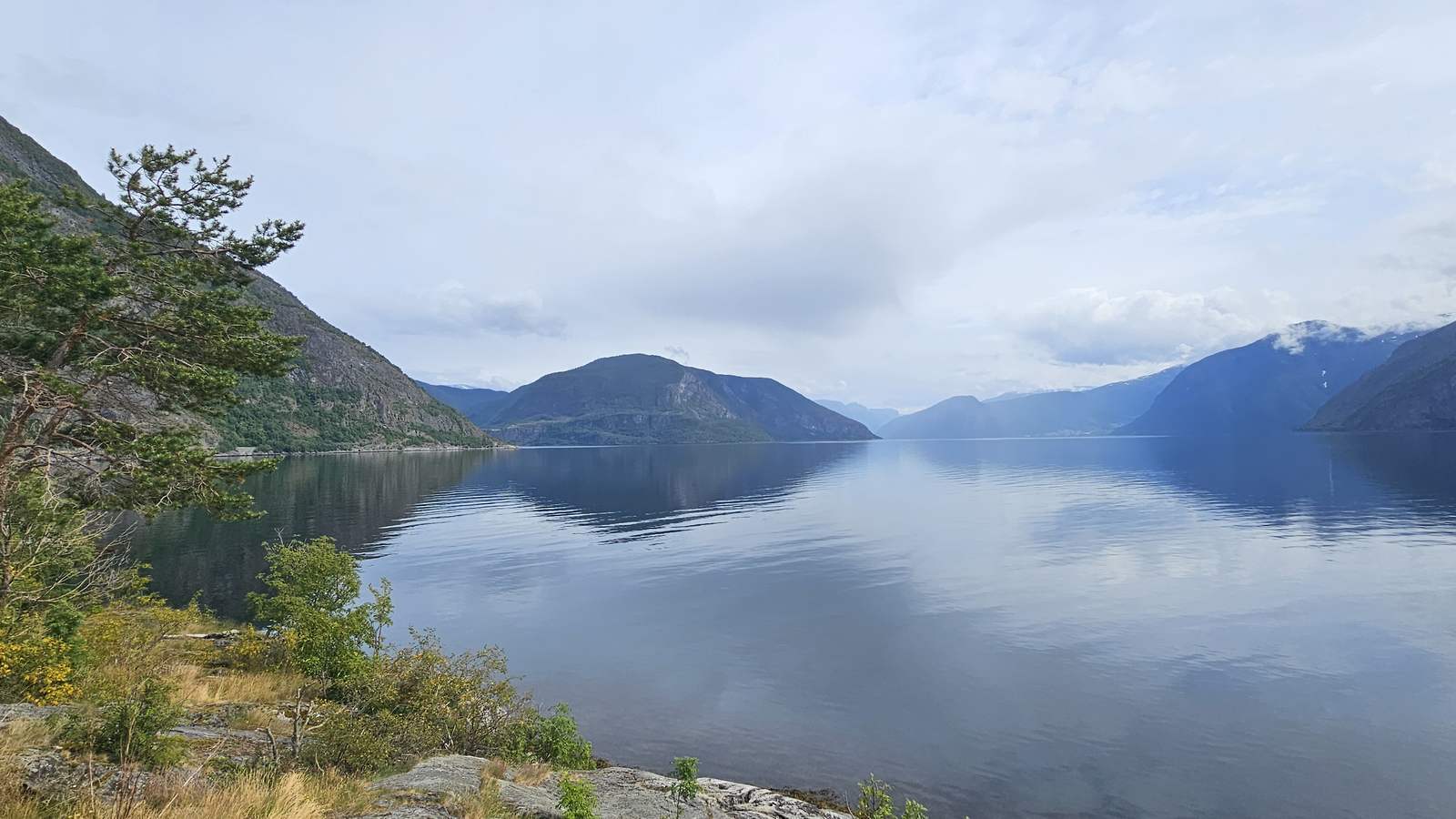
Overnight the ship calls briefly at Florø and Måløy, and at Torvik in the early morning, then rounds the headland called West Cape and reaches Ålesund by mid-morning. The town was rebuilt in the Art Nouveau style after the fire of 1904, and it lies across a string of islands with its fishing harbour at the centre. Climb the steps of Mount Aksla for the view, or visit the aquarium on the shore, one of the largest saltwater aquariums in northern Europe. Outside winter the ship calls here twice, once on arrival and again in the evening.
Between the two calls it sails into a fjord, and the month decides which. In May and September the ship enters Hjørundfjord, quiet and walled by the Sunnmøre Alps, with a stop at the village of Urke. In summer it goes on into Geirangerfjord, where the Seven Sisters waterfall falls beside old farms on the slopes; guests who go ashore there are carried by tender boat and are asked to arrive before 13:45. From October through April the fjords are not visited and the whole day belongs to Ålesund. The evening brings Molde, the City of Roses, facing a skyline of more than 200 peaks. The light changes through the year, so your guide sets the hours by sunrise and sunset for your dates.
Along the way
Floro Start of the day
Geiranger End of the day
The road of the day, on the coast. Select a point to read about the place.
The day, hour by hour
about 10:00 Arrive in Ålesund by mid-morning; Art Nouveau walk or the climb to Mount Aksla
13:45Excursion guests in Geiranger are asked to arrive before 13:45 for the tender boat, summer only
about 16:00 In May, September and summer: the fjord, Hjørundfjord or Geirangerfjord, from the deck
about 20:00 Return call in Ålesund outside winter
evening Molde and the view of more than 200 peaks across the water
Hjørundfjord in May and September; Geirangerfjord in summer; no fjord call from October through April.
In Geiranger the ship does not dock; excursion guests go ashore by tender boat.
Ålesund was rebuilt in Art Nouveau style after the fire of 1904.
Plan B. If cloud sits on the mountains, the fjord is still worth the deck, and Ålesund’s covered streets, the Art Nouveau centre and a long lunch on board fill the day.
Night: Ålesund
Day 3 Trondheim, a cathedral and the river cafes
The coast softens as you enter Trøndelag, a region the operator calls the historic heart of Norway, with farmland, wooded hills and sheltered fjords. Trondheim, founded in 997, was Norway’s first capital, and the ship stays for three hours. Walk to Nidaros Cathedral, built over the burial site of St Olav and sometimes called Norway’s Notre-Dame, then to the Archbishop’s Palace beside it, where the crown regalia are shown. Cross the old bridge, Gamle Bybro, into Bakklandet, where wooden warehouses line the river and the cafes open early.
This is the day for the coffee ritual, and Bakklandet is where to keep it: a cup and a pastry at a window over the Nid, and an hour with no plan. Those with energy climb to Kristiansten Fort for the view of the city and the fjord. Later the ship crosses the Trondheimsfjord and passes the ochre-red Kjeungskjær Lighthouse, built in 1880. Near Rørvik, in the Vikna archipelago, the land turns rockier and wilder, and many guests feel the voyage change from one Norway to another. The light changes through the year, so your guide sets the hours by sunrise and sunset for your dates.
Along the way
Alesund Start of the day
Trondheim End of the day
The road of the day, on the coast. Select a point to read about the place.
The day, hour by hour
about 12:00 Arrive in Trondheim; three hours ashore on the sailing plan
about 12:15 Walk to Nidaros Cathedral and the Archbishop’s Palace
about 13:30 Coffee and a pastry in Bakklandet, then the climb to Kristiansten Fort if you wish
about 16:00 Sail the Trondheimsfjord and pass Kjeungskjær Lighthouse
evening A short call at Rørvik in the Vikna archipelago
Three hours ashore in Trondheim, by the operator’s own text.
Nidaros Cathedral stands over the burial site of St Olav.
Bakklandet’s river cafes are a short walk from the cathedral.
Plan B. If rain falls, the cathedral and the palace are indoors, the cafes of Bakklandet are warm, and the ship’s lounges and lectures fill the afternoon.
Night: Trondheim
Day 4 Across the Arctic Circle, to Bodø and the Lofoten Wall
Helgeland comes first, a coast of islands and old legends, and an early riser may see the outline of the Seven Sisters mountain range. Early today the ship crosses the Arctic Circle, and the crossing is marked on deck with a ceremony the operator calls traditional and slightly silly, with sea spray as part of the rite. Beyond the line the land begins to change. The ship calls at Ørnes, a village near Svartisen, Norway’s second-largest glacier, and then at Bodø, beneath the Børvasstindan peaks.
Bodø was named a European Capital of Culture in 2024, and it is a walkable town for an independent hour. Nearby is Saltstraumen, the strongest tidal current in the world, where the water pours through a narrow strait in whirlpools. In the afternoon the Lofoten Wall rises from the sea, a chain of peaks that many guests rank as the memory of the voyage. The ship calls at Stamsund, where the harbour fills in the winter fishing season for the cod called skrei, and at Svolvær. If the light holds in the evening, the captain may turn into Trollfjord. The light changes through the year, so your guide sets the hours by sunrise and sunset for your dates.
Along the way
Trondheim Start of the day
Svolvær End of the day
The road of the day, on the coast. Select a point to read about the place.
The day, hour by hour
about 06:00 Sauna on board opens, daily until 22:00; Seven Sisters on the horizon
about 08:00 The Arctic Circle ceremony on deck
about 12:00 Ørnes, then Bodø; a walk in town or the optional trip to Saltstraumen
about 17:00 The Lofoten Wall comes into view; Stamsund and Svolvær
evening Trollfjord, if the captain judges the light and the weather right
The Arctic Circle is crossed early in the day, with a ceremony on deck.
Saltstraumen is the world’s most powerful tidal current, by the operator’s own text.
The captain turns into Trollfjord only where the light and the weather allow.
Plan B. If fog or wind closes the view, the day is the ceremony, a long lunch, the lectures on board and a warm hour in Bodø.
Night: Bodø
Day 5 Tromsø, the Arctic capital, and a night for the sky
At around breakfast time the ship is at Harstad, on Norway’s largest island, Hinnøya, between the islands of Vesterålen and the fjords of Troms. If you are up early there is a short stroll along the waterfront. The ship then calls at Finnsnes, where a bridge crosses to the island of Senja, and reaches Tromsø with four hours ashore. For centuries Tromsø was the starting point of polar expeditions, and today it has a university, a triangular cathedral with a stained-glass window across the water, and a compact centre of cafes, galleries and shops. The Arctic aquarium on the waterfront and the old brewery with its pub are an easy walk from the quay.
The sky decides what this day gives. The aurora season on the coast runs from October through March, and the operator promises nothing beyond the chance. From 20 May to 25 July Tromsø has the midnight sun, and from about 27 November to mid-January the polar night, with a few hours of twilight around midday. The operator lists dog sledding in the winter months and a city walk in all seasons. Leave a little time for the evening on deck, where the town lights fall behind and the mountains stand black against the sky. The light changes through the year, so your guide sets the hours by sunrise and sunset for your dates.
Along the way
Svolvær Start of the day
Tromsø End of the day
The road of the day, on the coast. Select a point to read about the place.
The day, hour by hour
about 07:30 Breakfast on board as the ship reaches Harstad and Finnsnes
about 14:30 Arrive in Tromsø; four hours ashore on the sailing plan
about 15:00 The waterfront, the Arctic aquarium and a coffee in the centre
about 18:30 Leave Tromsø in the evening light, or the dark
22:00The sauna on board closes; a last look at the sky from the deck
Four hours ashore in Tromsø, by the operator’s own text.
The aurora season on the coast runs from October through March; it is a chance and never a promise.
Tromsø has the midnight sun from 20 May to 25 July.
Plan B. If the sky is shut, the day is a long walk in Tromsø, the aquarium, a warm afternoon in the lounge and an early night.
Night: Tromsø
Day 6 Hammerfest, the North Cape and the Barents coast
Hammerfest comes at dawn, a town on the island of Kvaløya where reindeer roam, often called one of the northernmost towns in the world. The coast then opens and turns wild, with low islands and bare headlands facing the Arctic Ocean, on the way to Havøysund. At Honningsvåg you have almost four hours ashore. The road across the island of Magerøya runs through treeless land to the North Cape, where a globe monument stands on the cliff above the Arctic Ocean, and where nothing lies to the north but sea.
Birdwatchers can choose an excursion to the colonies along the coast. Back on board the ship calls at Kjøllefjord and passes Finnkirka, a rock formation that rises from the shore like a built tower, then calls at Mehamn, the northernmost port of call. Near Berlevåg it passes Slettnes Lighthouse, at 70 degrees 45 minutes north the northernmost mainland lighthouse in the world. In the night the ship calls at Båtsfjord and Vardø. North Cape has the midnight sun from 13 May to 31 July. The light changes through the year, so your guide sets the hours by sunrise and sunset for your dates.
Along the way
Tromsø Start of the day
Honningsvåg End of the day
The road of the day, on the coast. Select a point to read about the place.
The day, hour by hour
about 06:00 Sauna on board opens; Hammerfest in the early morning light
about 12:00 Honningsvåg; almost four hours ashore, or the optional trip to the North Cape
about 16:00 Kjøllefjord and Finnkirka from the deck
about 19:00 Mehamn, then Slettnes Lighthouse near Berlevåg
night Båtsfjord and Vardø while you sleep
Almost four hours ashore in Honningsvåg, by the operator’s own text.
Mehamn is the northernmost port of call on the route.
North Cape has the midnight sun from 13 May to 31 July.
Plan B. If wind or snow closes the road to the North Cape, the excursion is replaced by a walk in Honningsvåg, and the coast from the deck is the day.
Night: Honningsvåg
Day 7 Kirkenes, the frontier town, and the turn south
Kirkenes is the end of the line northbound, a frontier town near the border. The ship reaches it after a night along the Varanger Peninsula, a coast under one of the Arctic’s main bird migration routes, and the town has a history shaped by trade, diplomacy and life in the far north. During the Second World War it was one of the most heavily bombed places in Europe, and traces of that history remain. The museums tell the story of the war years and the multicultural north, and the operator lists a border excursion on this day in every season.
The southbound voyage begins here in the afternoon. The ship sails northeast along the Varanger coast and passes Hornøya, a bird island where, depending on the season, you may see puffins, gannets, guillemots and razorbills, and sea eagles over the cliffs all year. It calls again at Båtsfjord, and the ports you passed in the night are now seen by day, since the operator notes that those visited at night on the way north are seen in daylight on the way south. In Kirkenes the polar night runs from late November to 21 January. The light changes through the year, so your guide sets the hours by sunrise and sunset for your dates.
Along the way
Honningsvåg Start of the day
Kirkenes End of the day
The road of the day, on the coast. Select a point to read about the place.
The day, hour by hour
about 08:00 Arrive in Kirkenes after the Varanger coast; the morning is ashore
about 10:00 Museum or the optional border excursion, at your pace
about 14:00 The voyage turns south; the ship leaves Kirkenes in the afternoon
about 17:00 Hornøya, the bird island, from the deck
evening Båtsfjord, and a quiet dinner on board
Kirkenes is the turning point of the voyage.
The ports passed at night on the way north are seen by day on the way south.
Kirkenes has the polar night from late November to 21 January.
Plan B. If the weather closes the border excursion, the museums are indoors and the harbour walk is short, so the morning is easy to fill.
Night: Kirkenes
Day 8 Hammerfest again, the whale coast and the Lyngen Alps
Hammerfest returns in the early morning, and this time there is time to find the Meridian Column. UNESCO recognises it as part of the Struve Geodetic Arc, a scientific project that measured the shape of the planet. Nearby the Polar Bear Society shows the town’s Arctic heritage. Those who want exercise can walk up Mount Salen for the view. The ship then calls at Øksfjord, a village below steep peaks, where the land leaves the open spaces of Finnmark behind, and at Skjervøy, an island community with a long fishing tradition.
As the waters cool through autumn and winter, herring gather around Skjervøy, and the orcas and humpback whales follow them. The seas here are rich in life all year. In the evening the jagged Lyngen Alps rise to the east above the fjords, and late at night the city of Tromsø appears as a scatter of lights beneath the mountains, one of the most atmospheric approaches of the voyage. In the aurora season, from October through March, the deck is the place to be after dinner, though the sky gives no promise. The light changes through the year, so your guide sets the hours by sunrise and sunset for your dates.
Along the way
Kirkenes Start of the day
Tromsø End of the day
The road of the day, on the coast. Select a point to read about the place.
The day, hour by hour
about 07:00 Hammerfest in the early morning; the Meridian Column and the walk up Mount Salen
about 12:00 Øksfjord and the open sea beyond
about 15:00 Skjervøy; watch for whales from October through winter
about 19:00 Dinner on board while the Lyngen Alps pass to the east
22:00The sauna on board closes; Tromsø’s lights at night
The Meridian Column in Hammerfest is recognised by UNESCO.
Whales gather around Skjervøy as the water cools in autumn and winter.
The ship reaches Tromsø late in the evening.
Plan B. If the sea is rough, the whale watching moves to the windows of the lounge, and the day is Hammerfest on foot and the lectures on board.
Night: Tromsø
Day 9 Harstad, Vesterålen, Trollfjord and Svolvær
Vesterålen fills the morning, and the ship calls first at Harstad, where Trondenes Church, the northernmost medieval stone church in the world, dates from the 13th century. After a call at Risøyhamn, the smallest port on the route, the ship reaches Sortland, called the Blue City for its colours. The operator lists a trip of about four hours from Harstad to Sortland, called A Taste of Vesterålen. The ship then reaches Stokmarknes, the birthplace of the coastal voyage, where a captain began the service in 1893.
Allow time for the coastal-voyage museum, with the preserved ship built in 1956 inside its glass hall. Leaving Stokmarknes, the ship sails through the Raftsund strait. Weather, time of year and light permitting, the captain may turn into Trollfjord, only about two kilometres long and barely 100 metres wide at its mouth, with mountain walls rising almost straight from the water. The ship turns within it, and sea eagles often glide overhead. The day ends at Svolvær, in the Lofoten Islands, below the twin peaks called the Svolvær Goat, with the Lofoten Wall behind. The light changes through the year, so your guide sets the hours by sunrise and sunset for your dates.
Along the way
Tromsø Start of the day
Svolvær End of the day
The road of the day, on the coast. Select a point to read about the place.
The day, hour by hour
about 07:00 Harstad and Trondenes Church; the optional Taste of Vesterålen trip
about 11:00 Risøyhamn and Sortland, the Blue City
about 13:00 Stokmarknes and the coastal-voyage museum
about 16:00 Raftsund and, if the captain allows, Trollfjord
evening Svolvær and the Lofoten Wall
Trondenes Church is the northernmost medieval stone church in the world.
Stokmarknes is where the coastal voyage began in 1893.
Trollfjord is entered only where weather and light allow.
Plan B. If the weather keeps the ship out of Trollfjord, the Raftsund strait is still narrow, steep and worth the deck, and the museum fills the long call.
Night: Svolvær
Day 10 The Helgeland coast, the Seven Sisters and the hole in Torghatten
This morning the ship crosses the Arctic Circle again, going south, and leaves the far north behind. It calls at Ørnes and then threads the Helgeland coast, thousands of islands, skerries and sheltered waterways that have given seafarers safe passage for centuries. After Sandnessjøen, the Seven Sisters rise above the islands. By local legend they were seven troll princesses fleeing an unwanted suitor, who were caught by the sun and turned to stone. Ask the crew for the version they prefer, and decide for yourself.
At Brønnøysund you have more than two hours ashore, enough for the marina, the 1870 church and a cafe. Later the ship passes Torghatten, a mountain on a small island with a hole through its centre, 35 metres high and 160 metres long, and the captain manoeuvres so that you can see through it. Local legend says it was the hat of a troll king. The ship then calls at Rørvik, in the island-rich Vikna archipelago. The evening is best spent on deck among the islands of Vikna. The light changes through the year, so your guide sets the hours by sunrise and sunset for your dates.
Along the way
Svolvær Start of the day
Brønnøysund End of the day
The road of the day, on the coast. Select a point to read about the place.
The day, hour by hour
about 07:00 Ørnes and the Arctic Circle, southbound, early in the morning
about 10:00 Sandnessjøen and the Seven Sisters on the horizon
about 14:00 Brønnøysund; more than two hours ashore
about 16:30 Torghatten and the hole, from the deck
evening Rørvik in the Vikna archipelago
More than two hours ashore in Brønnøysund, by the operator’s own text.
The hole in Torghatten is 35 metres high and 160 metres long.
The Seven Sisters rise above the islands after Sandnessjøen.
Plan B. If rain or cloud hides the peaks, the legend still travels with the ship, and the long call at Brønnøysund and a lunch on board carry the day.
Night: Brønnøysund
Day 11 Trondheim by morning, then Kristiansund and Molde
Trondheim fills the morning, and if you saw the city on the way north, this is the chance for a different side of it. The ship stays several hours. Take an unhurried breakfast or coffee in Bakklandet, browse the independent shops before they fill, and walk up to Kristiansten Fort for the view across the roofs and the fjord. If you did not see Nidaros Cathedral, look at it from outside, and note how it stands over the burial site of St Olav.
In the afternoon the ship crosses the Trondheimsfjord and returns to the open coast, with fertile farmland, low islands and small settlements that are best seen from the water. Kristiansund is one of Norway’s main fishing ports, built across four islands linked by bridges and ferries. It is famous for klippfisk, salted cod dried on coastal rocks and sold to Portugal and Spain as bacalao, and its statues honour the women and children of the trade. In the evening comes Molde, the City of Roses, with more than 200 peaks across the fjord. The light changes through the year, so your guide sets the hours by sunrise and sunset for your dates.
Along the way
Brønnøysund Start of the day
Kristiansund End of the day
The road of the day, on the coast. Select a point to read about the place.
The day, hour by hour
about 08:00 Trondheim, several hours ashore in the morning
about 09:00 Coffee in Bakklandet and the climb to Kristiansten Fort
about 14:00 The Trondheimsfjord and the open coast
about 18:00 Kristiansund, the klippfisk town on four islands
evening Molde and the Molde Panorama
Kristiansund is built across four islands linked by bridges and ferries.
Klippfisk is salted cod dried on coastal rocks and sold as bacalao in Portugal and Spain.
Molde faces a chain of more than 200 peaks.
Plan B. If rain falls, the cafes of Bakklandet are warm, the cathedral is a short walk, and the klippfisk dishes on board bring Kristiansund to the table.
Night: Kristiansund
Day 12 Fjords of the west and home to Bergen
The last day begins in the dark, with a late call at Ålesund for those who stay up. Måløy follows, one of Norway’s main fishing ports, and then the entrance to Nordfjord, one of the longest fjords in the country, which leads towards Jostedalsbreen, the largest glacier on mainland Europe. Florø comes next, Norway’s westernmost town, built on islands open to the sea. Leaving it the ship passes Stabben Lighthouse on its rocky outcrop, a landmark for sailors for more than a century, and then crosses the mouth of Sognefjord, Norway’s longest and deepest fjord.
As the day goes on, the scenery grows gentler and more settled, with islands, skerries and sheltered channels, and you enter Bergen by the Hjeltefjord, past the last islands and the first coloured houses. The ship arrives back in Bergen at 14:45, and your driver is waiting at the terminal to take you to your hotel or to Bergen Airport, 20.2 km and 27 minutes by the routing estimate. If your flight leaves in the evening there is time for a last walk through Bryggen. The coast has shown its many faces, and the journey ends where it began. The light changes through the year, so your guide sets the hours by sunrise and sunset for your dates.
Along the way
Kristiansund Start of the day
Bergen Airport End of the day
The road of the day, on the coast. Select a point to read about the place.
The day, hour by hour
about 06:00 Sauna on board opens; Måløy and Nordfjord in the early light
about 11:00 Florø, then Stabben Lighthouse and the mouth of the Sognefjord
about 13:30 Hjeltefjord and the last islands before Bergen
14:45The ship arrives in Bergen; your driver meets you at the terminal
about 15:30 Drop-off at your hotel or at Bergen Airport, 27 minutes by the routing estimate
The ship arrives in Bergen at 14:45, by the operator’s own page.
Bergen’s terminal to the airport is 20.2 km and 27 minutes by the routing estimate.
Your driver confirms the pickup the evening before.
Plan B. If the ship is late, your driver adjusts the pickup, and if you fly in the evening the margin is kept so that the airport is never rushed.
Night: Bergen (departure, no further night)
While you are there
Festivals, markets and local events change from year to year. Tell us your dates and we will check what is on along this route and fold it in.